./ 2023

The Vanishing Cloud Forest

An immersive map and micro-environment that makes an island’s delicate ecology legible
Details

Tools
  • TouchDesigner
  • Bare Conductive
  • Blender
  • Reaper
Team
Chloe Chan

Lead Visual Designer & Concept Researcher

Titian Sze

Digital Artist & 3D Designer

Yoki Yu

Prop & Visual Designer

Joseph Vaz Nicholas

Producer & Graphic Designer

Leonardo Mussatto

Technical Lead & Sound Designer

./ introduction

The Vanishing Cloud Forest is an installation showcase the research and restoration work of the Saint Helena Research Institute. Conceived as our major project for the Contemporary Media Practice degree at the University of Westminster, the installation combines an interactive 3D tabletop map, projection mapping, and a binaural soundscape to give visitors an embodied, layered view of the cloud forest ecosystem on Diana’s Peak.

At its heart, the project investigates how we can translate scientific data into a sensory, empathic encounter that invites awareness and action. The exhibition thus balances factual clarity with moments of immersion - a panoramic room suggests the sight and sound of the forest while an interactive map invites exploration of the collected data and complementary text and QR-linked resources give further insight on threats and restoration interventions.

./ development

Core Idea

The core idea for the project took shape during multiple brainstorming session where we outlined technologies, techniques, and themes we wanted to explore in our major project. The final shape of the project, however, emerged after we stumbled on the Saint Helena Research Institute’s work during a visit to the Kew Gardens. The eventful history of this small island and its unique ecosystem are a striking example of how human intervention can have both detrimental and beneficial effects on the environment. Thanks to institute being open to collaboration we were able to access ecological reports, species lists, restoration strategies, and photographic material collected by researchers over the years. These materials shaped the narrative and structure of our installation. Our objectives were threefold:

  • Communicate: present the Institute’s research in a informative but easily digestible way, so that non-specialists can become aware of the issue without being overwhelmed.
  • Engage: invite exploration and active discovery through an interactive 3D map that reveals multiple layers of ecological data.
  • Evoke: create an immersive atmosphere that supports a bodily, empathic connection to the place and its stakes to encourage curiosity and potential action.

./ development

Informative Space

Entering the exhibition, visitors are first welcomed by the informative section presenting the Cloud Forest, its ecosystem and its history. This space aims to introduce visitors to the exhibition and provide the scientific and historical background necessary to critically engage with the ecological issues the island of Saint Helena is currently facing.

Placed at the centre of the room, the tabletop map is key to the exhibition’s pedagogic intent: it is a physical, legible object that visitors can engage with to intuitively get an insight into the large amount of data collected through the years. Complementary information on the history of the island and the restoration efforts is displayed on the walls though a combination of text, images, sketches, and graphics. For those interested in diving deeper, QR codes give access to the scientific body of research made available by the research institute.

  • Visual language

    Maps provided by the institute were vectorised, split into layers, and paired with labels and brief explanatory text. We prioritized legibility: clear labels and typeface, intuitive colour palette and UI

  • Physical fabrication

    The cleaned 3D model of the island was CNC milled into two lightweight sheets of expanded polystyrene at the university workshop; glued, sanded, and painted, the relief map became the projection surface. This both increased legibility and helped grab visitors attention

  • Interaction hardware

    Capacitive sensors - thin copper-tape strips under a thin MDF board - read touches around the circular table. Two chained Bare Conductive boards streamed event data to TouchDesigner via Serial-over-USB. Paired with the projection, capacitive input felt immediate and intuitive

  • Software orchestration

    TouchDesigner handled selection logic and transitions between map layers and relative complementary text. Distributing UI elements and text around the table, visitors were invited to explore the island - and conceptually the issue itself - from multiple sides; touchpoint prioritisation favoured sequential interaction to prevent sudden changes

Image Gallery

Image Gallery

Image Gallery

./ development

Immersive Space

A second strand of work focused on immersive visuals and audio to create a more bodily connection between visitors and the issue presented by the exhibition.

  • Asset creation & rendering

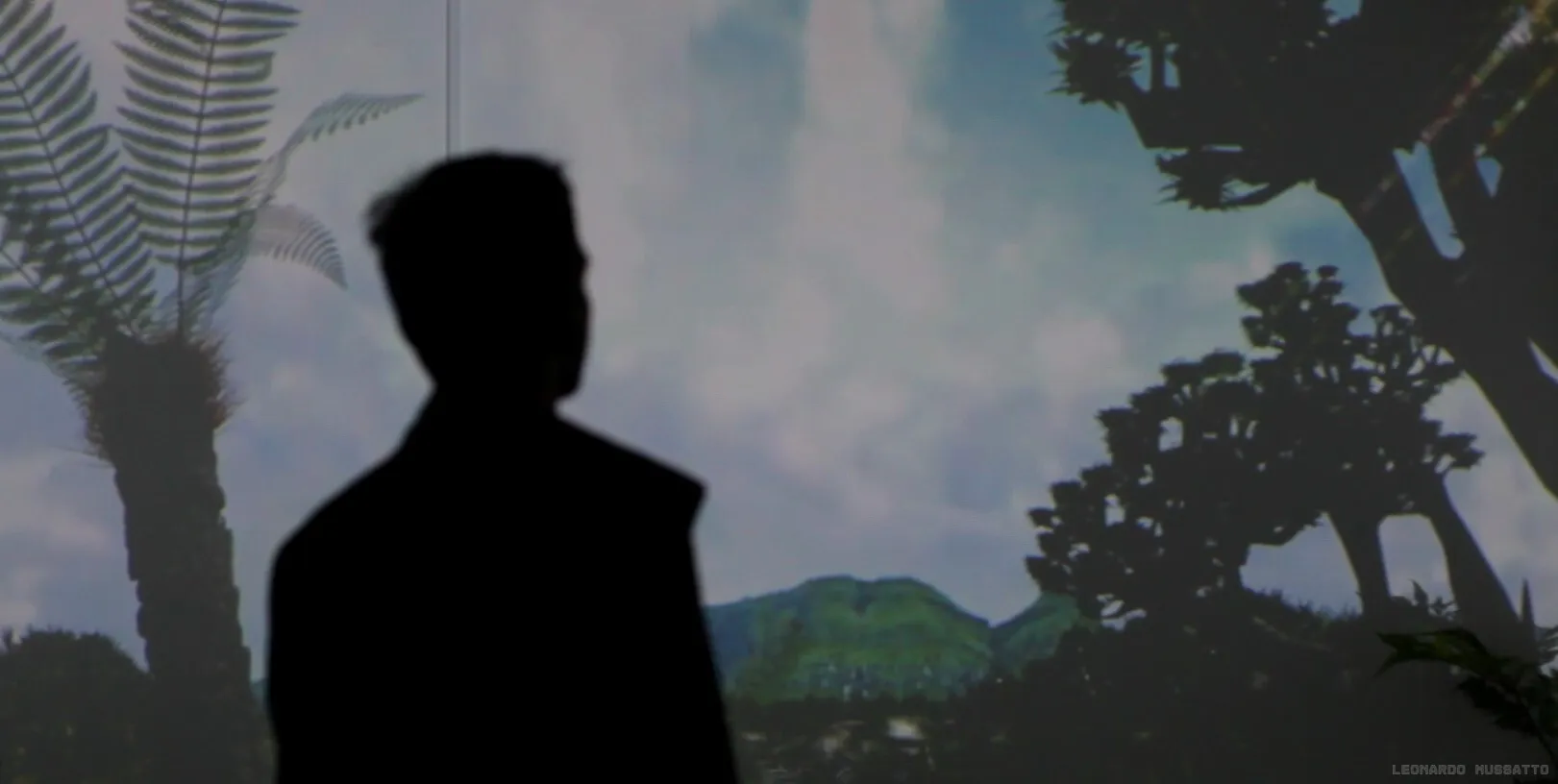
    Blender was used to model plants and landscape elements sourced from the Institute’s photographic records. These assets were composed into a realistic environment and pre-rendered into a looping video

  • Projection mapping

    For the tabletop interface, TouchDesigner output was routed into MadMapper to align map layers and UI with the model and the capacitive sensors; for the immersive room, we instead relied on MiniMads to coordinate the four projectors at our disposal

  • Soundscape

    A layered soundscape of birds, insects and ambient textures was assembled in Reaper to evoke the cloud forest fauna. A voice actress recorded a short audio guide that leads visitors through the panoramic space and highlights key species and interventions

  • Spatialization

    The soundscape was played back on small loudspeakers; the spoken track was mixed with the ambient texture, rendered in binaural format and accessed by visitors through headphones freely available inside the room. This allowed us to create a sense of environmental depth and intuitively direct visitors attention on various elements of the virtual panorama, while accommodating the site constraints

Silhouette of a visitor against the projected virtual reconstruction of a panoramic viewpoint in the Saint Helena Diana's Park

./ outcome

Constraints & Trade-offs

The initial project proposal was rather ambitious, proposing to extend the landscape beyond the limits of the room by blending physical and virtual models, with special care for textures, sound, scent, temperature, and humidity in order to address all senses and transport visitors into this fascinating and not easily accessible landscape. Budget, schedule and venue constraints, however, required us to refocus our scope:

  • We prioritized the interactive map and the panoramic view, accepting compromises on tactile props and limiting additional environmental effects to grass carpets and forest-evoking scent.
  • Real-time weather-driven rendering was prototyped but shelved in favour of pre-rendering as it would have required higher spec hardware without significantly increasing its efficacy.

These pragmatic choices preserved core experience goals while keeping the project deliverable within the available resources.

  • What should be improved
    • Capacitive sensors required more robust wiring and layout; accuracy and long-term reliability would benefit from custom PCBs or more appropriate cabling solutions.
    • Projection mapping was satisfactory, but long term installation would require more robust solutions, especially in terms of calibration.
    • The immersive room achieved atmosphere but not the full multisensory immersion originally imagined. A site visit to Saint Helena and collaboration with the institute for field recordings and scans would improve fidelity and authority.
  • What worked
    • The interactive map successfully translated complex datasets into short, discoverable interactions.
    • TouchDesigner + Bare Conductive capacitive sensing produced an intuitive interaction model that invited multiple visitors to engage.
    • Pre-rendering the panoramic room gave us high visual quality without requiring expensive hardware on-site.