./ 2021
Play For The Future
A collaborative tabletop prototype about energy, resource trade-offs and long-term planning
Details
- Tools
- Team
Leonardo Mussatto


./ introduction
Play For The Future is a prototype multiplayer tabletop game and installation that probes how games can simplify complex socio-technical issues to support reflection and shared decision-making. Sparked by a personal interest in cooperative and resource-management games, and a curiosity about XR, the project investigates how a social, turn-based tabletop game can help visitors explore trade-offs in energy solution and the long-term effects of collective choices; it was developed as a prototype during lockdown and was not publicly exhibited or formally play tested.
Designed as a liminal museum foyer or communal-space experience, the prototype aims to be approachable for passers-by yet rich enough for sustained play: players take role-specific responsibilities (e.g., energy, infrastructure) while sharing resources and collectively steering global indicators like happiness and pollution. The playable prototype demonstrates core mechanics and interaction patterns; it is intended as an exploratory proof-of-concept rather than a finished game.
./ outcome
Limitations & Trade-offs
This was a solo project produced during the Media Explorations - Interactive Media module at the University of Westminster. The module introduced me to the discussion around tabletop interfaces, interactive installations, and user interfaces and the prototype allowed me to explore the use of Blender and Unreal Engine for a tabletop installation. This lead me to prioritize core mechanics and social dynamics rather than full content and visual polish.
What should be improved
- No formal playtesting or public exhibition took place. This limits any claim about player behaviour or learning outcomes.
- The prototype lacks research trees, tooltips, and a polished onboarding flow — all crucial to introduce newcomers into meaningful play.
- The central dashboard and UI remain rough and need clearer, rapidly interpretable visualisations to reduce cognitive load for casual players.
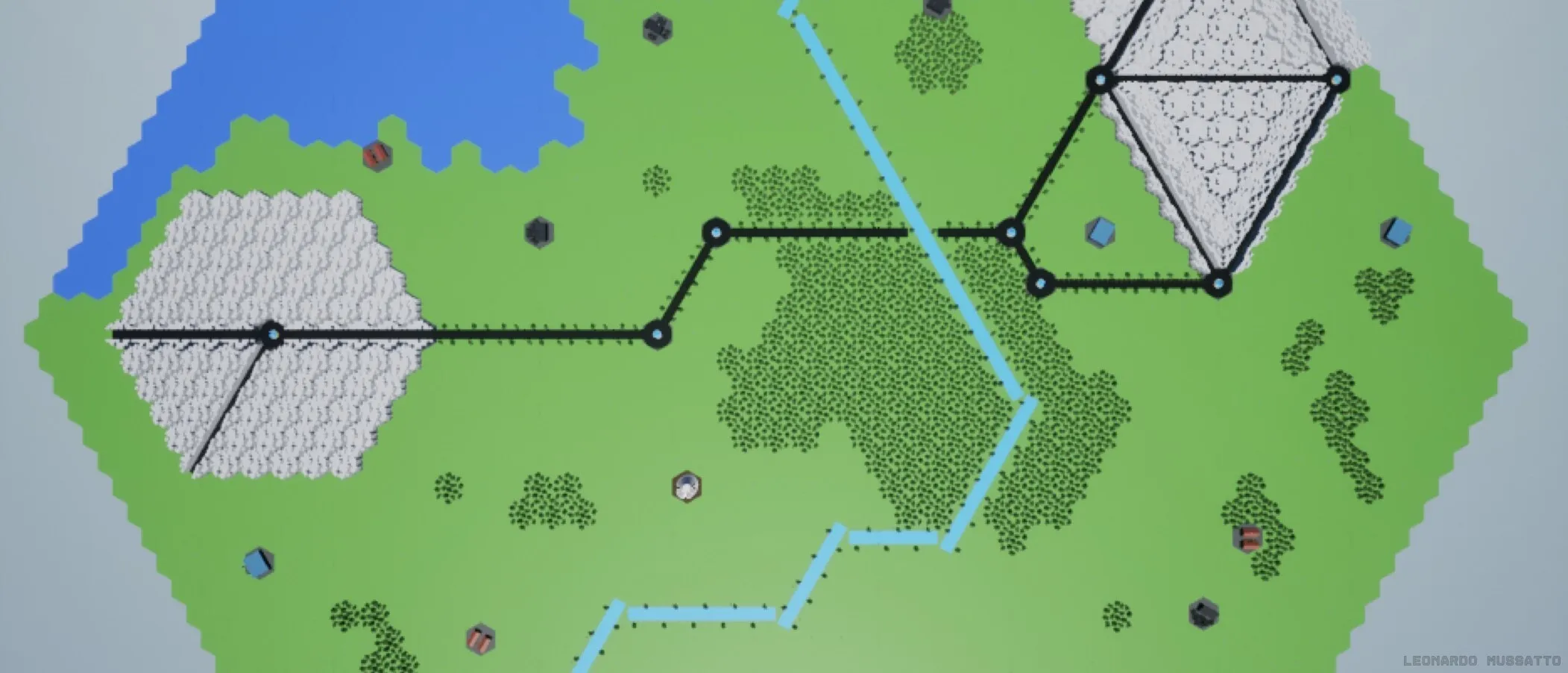
- Visual legibility from a top-down view reduced the usefulness of 3d tiles; it could be interesting to explore the implementation of Trompe l’Oeil or pepper-ghost techniques.
- While being clearly recognisable, hand crafted tiles provide limited variation. Procedural generation could improve visual variety and in turn appeal - relevant for an installation meant to grab the attention of passers-by.
What worked
- Prototyping quickly in Unreal allowed testing of turn and action-cost logic without fully implementing all assets.
- Keeping the prototype modest (few roles, simple tiles) helped reveal which interactions matter most.